For residential aged care
Know your AN-ACC position, your care minutes and the money at stake
Casemix, funding per bed day, occupancy, residents sitting on a default class, care minutes against each home's own target, and the reclassifications nobody lodged. One screen per question, with a date on every number.
Every picture on this page is our example company, with sample data.
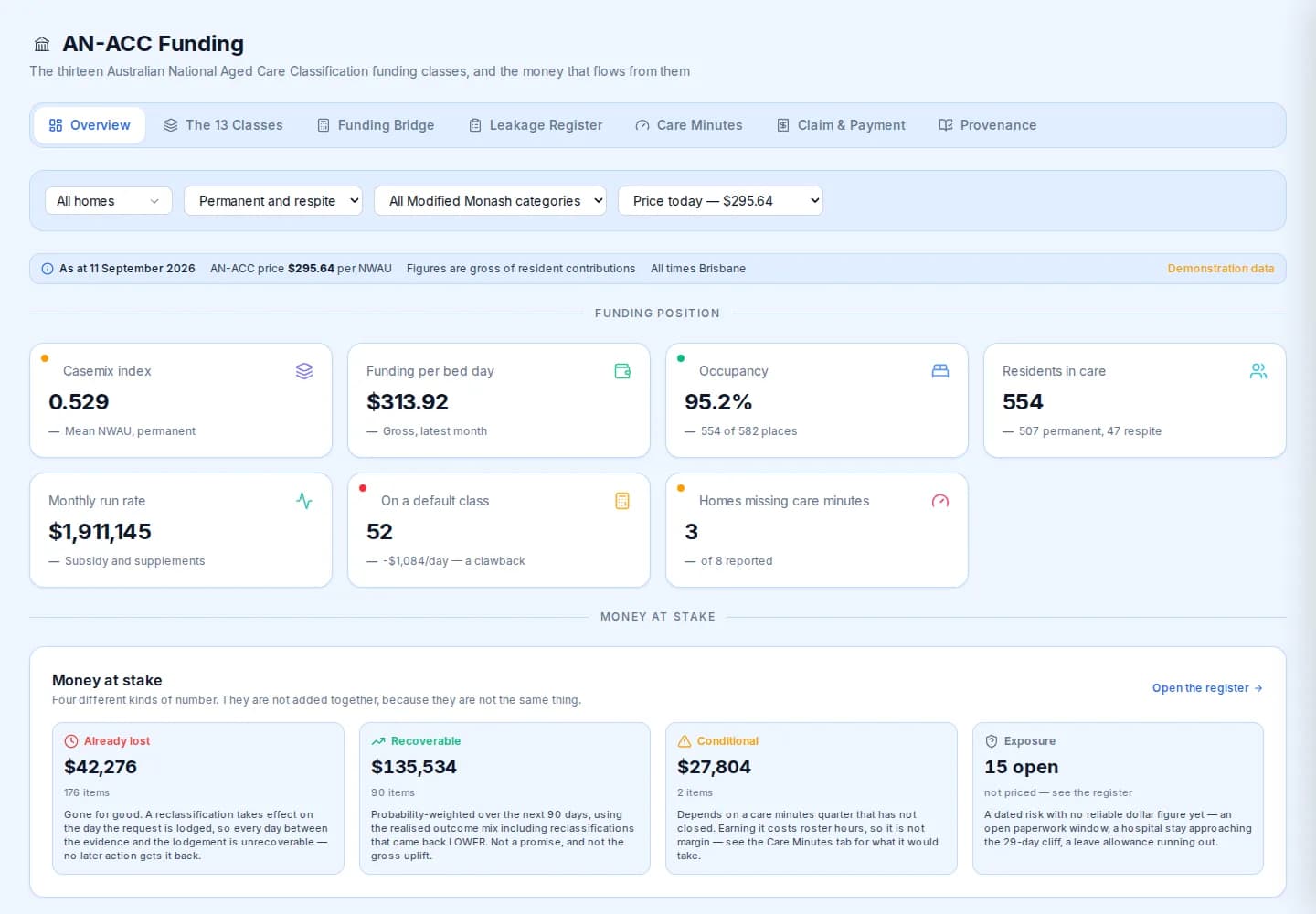
What you see
AN-ACC funding, care minutes against each home's own target, and the money at stake.
What you need
Exports from your resident system, rostering, payroll and payment statements.
How you start
A 15 minute call, then a working session on one home's data.
The reason
Why aged care providers ask for this
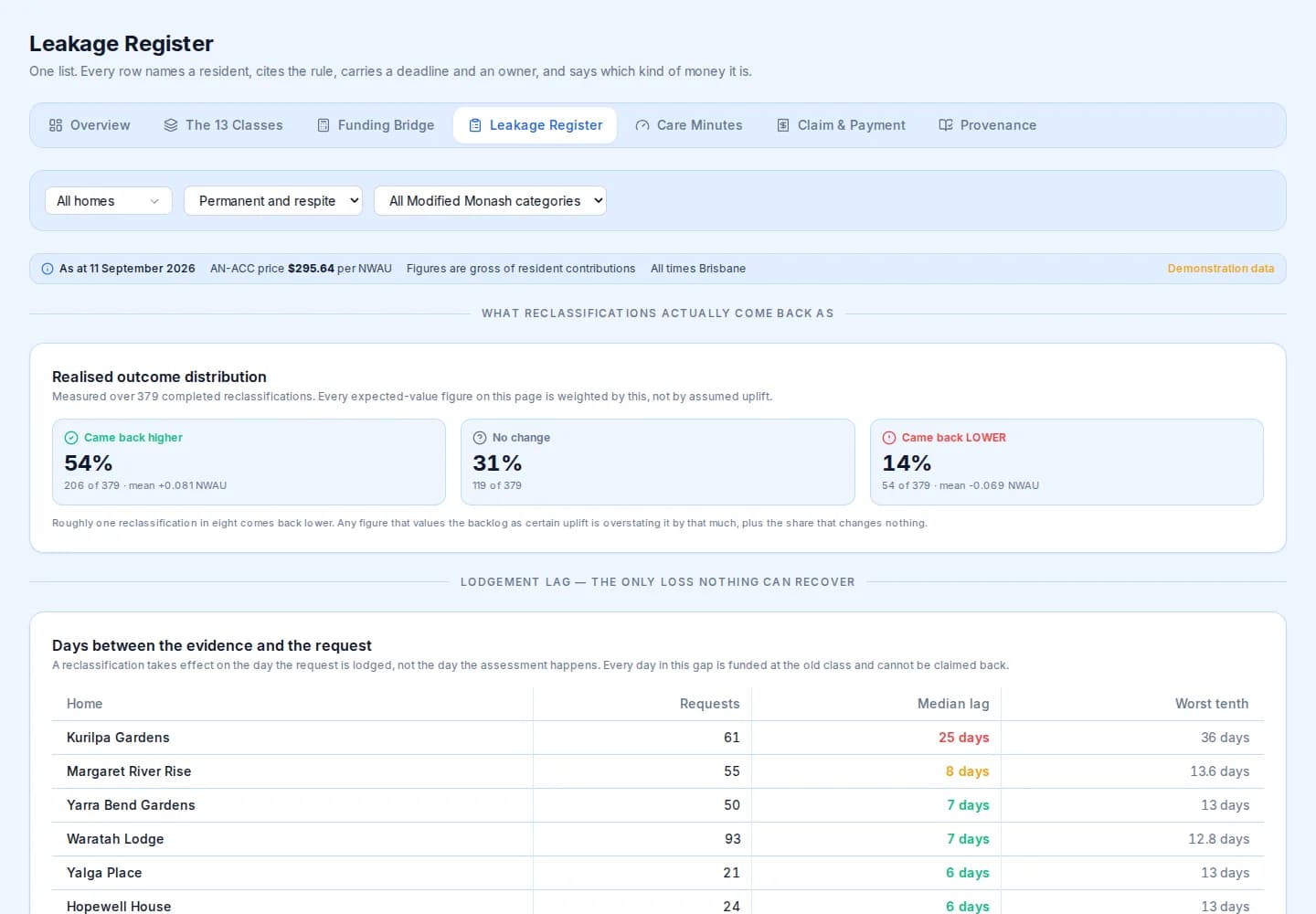
Under AN-ACC the money follows the classification, the classification follows the evidence, and the evidence has a date. A reclassification lodged a week late is funded at the old class for that week, and no later action gets it back. Most homes only see that in the quarterly reconciliation, when it is a number rather than a decision.
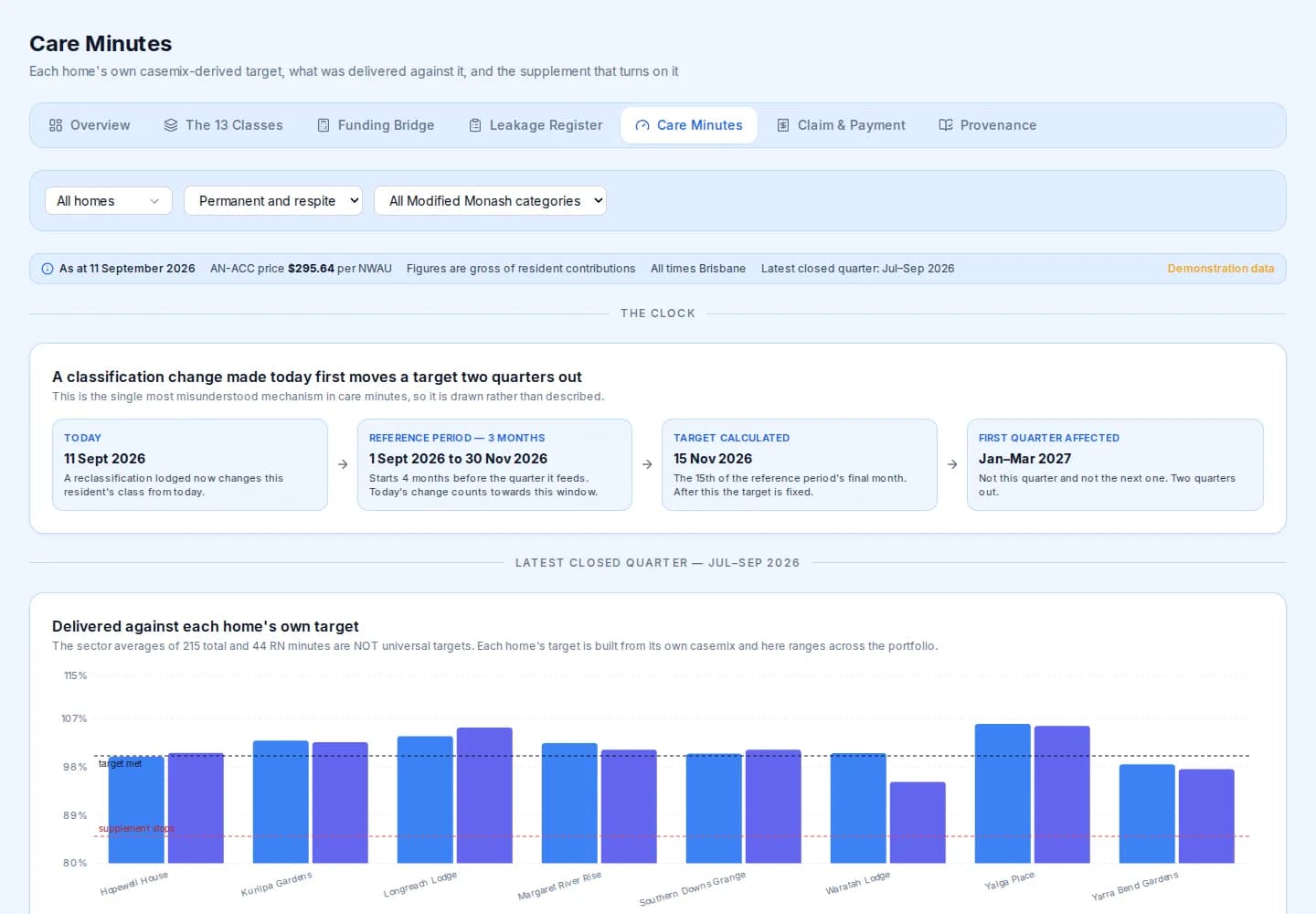
MERIT Lumina is built around the questions a director of nursing, a finance manager and a board ask each other: what is our casemix index, what are we earning per bed day, who is on a default class and why, are we delivering the care minutes each home's own casemix requires, and how much funding is already lost, still recoverable, or conditional on a care minutes quarter that has not closed.
Good to know. Every figure on the AN-ACC screens says when it is as at and what price it uses. The four kinds of money are never added together, because they are not the same thing.
See it working
Three questions, three screens
Pick a question to open the screen that answers it. These are real screens of the platform, filled with sample numbers.
Measures
What residential aged care providers watch here
The list is a starting point. We agree yours with you.
Every measure has
- A target
- A trend
- An owner
- Funding
Casemix index
Mean NWAU per permanent resident, the single number the funding follows.
- Funding
Funding per bed day
Gross subsidy and supplements per occupied bed day, latest month, at today's AN-ACC price.
- Delivery
Occupancy
Occupied places against operational places, permanent and respite shown separately.
- Funding
Residents on a default class
Who is being funded at a default class, how long for, and what it costs per day.
- Quality
Care minutes against target
Each home's delivered minutes against its own casemix-derived target, not a sector average.
- Accountability
Lodgement lag
Days between the evidence and the reclassification request, the only loss nothing can recover.
- Funding
Money at stake
Already lost, recoverable, conditional and exposure, kept as four numbers.
- Workforce
Staff retention
The share of care staff still with you, home by home, because care minutes depend on it.
How it works
Four plain steps, no new system
Nothing new for your staff to type into.
- 1
Start with the data you already have
Exports and spreadsheets from your client, rostering, finance and HR systems. Nothing new to type in.
- 2
We set it up with you
Together we agree which measures matter, what a good number looks like, and who owns each one.
- 3
Thresholds, owners and exceptions
When a number crosses its line, it becomes an exception with an owner and a due date, not a surprise at the next board meeting.
- 4
Actions and evidence
Every action, status change and sign-off is kept, so the story of what you did about it is there when someone asks.
- Where does the data come from?
- From the exports you already produce: your clinical or resident system, rostering, payroll and the Services Australia payment statements. We load them with you and agree the rules before the first number shows.
- Are the pictures on this page real?
- They are real screens of our example company, Merit Lumina (Demo), filled with sample homes and residents. Nothing on this page is a provider's data. Your version is built from your own exports.
- Does it cover home care?
- The screens shown are for residential care under AN-ACC. The same approach, measures agreed with you and loaded from your exports, can be set up for home care programs. Ask on the call.
See your own AN-ACC position
Fifteen minutes to decide whether a working session on one home's data is worth your time.